The Storm destroys the Church in Kjelvik

In English & På norsk

About the hurricane that raged in Kjelvik when the church was destroyed, Olaf Simonsen writes in «Vestfinmarken» on Monday, October 13, 1930:

«The hurricanes of January 16 and February 4, 1882 are described as the most violent storms that have ever haunted Finnmark. During these, Kjelvik Church was completely blown down. It is said in accounts from the time that no log was found left on log; stumps and pieces of timber lay several hundred meters up in the mountains.»

Olaf Simonsen further writes that the official report states that «…the materials were so battered that none could be used in the construction of a new church.»

The last church in Kjelvik was built in 1844, and taken by the storm in 1882, after 38 years. Photo from Ytreberg, N.A. (1980) The trading post in Finnmark, History – Commerce – Travel and festivity, F. Bruns Bokhandels Forlag, 2nd edition, Trondheim

The strong storm that destroyed the church in Kjelvik and also shattered many of the piers in Hammerfest, and ravaged the fishing village of Berlevåg. Here, the storm that came in from the sea destroyed many of the fishing boats.

The parish had been left without a church, and work was started to get a new one, and of course without it taking too long. While waiting for a new church, the church activities were carried out in Porsangvik, where the schoolhouse was put into use. As a replacement for the church that was lost, Kjelvik received a small parish house, a building that went by the name of «Kirkestua». We can see it where it is set up between the school and the teacher’s residence.

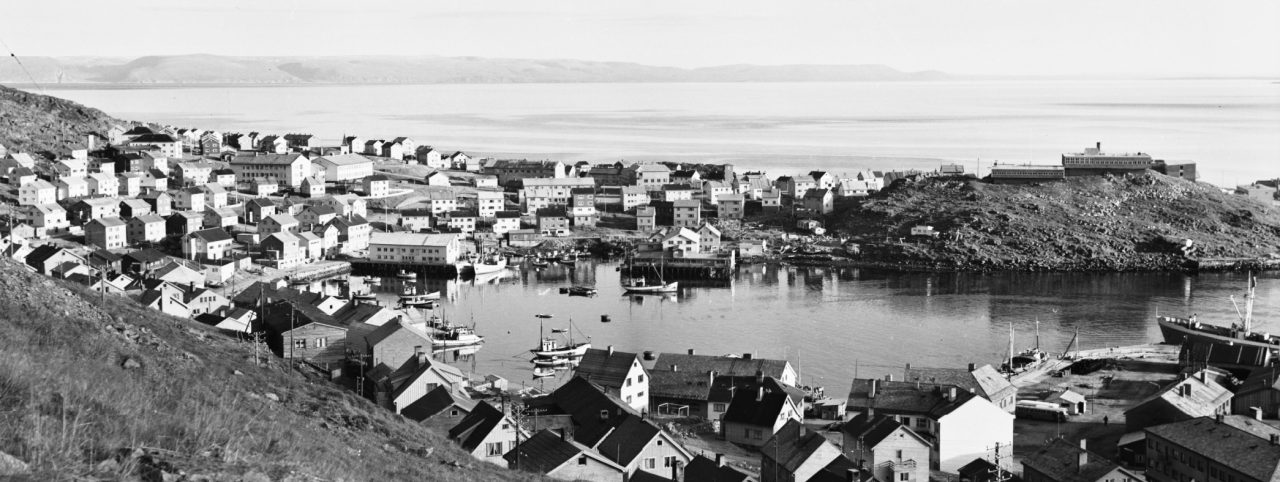
When we become familiar with what is told here, we have the background to see what it was like at the time when Kjelvik lost its church. In the picture below, we see how it eventually looked where the church had stood.

The churchyard, in the middle of the picture, was intact in 1941 when the picture above was taken. In the picture we have the teacher’s residence, the church hall and the school, three white buildings, with Ottar Olsen as the source. The picture was taken by Elisabeth Meyer when she was in Kjelvik in the summer of 1941.

In the newspaper Finmarksposten, which was then published in Hammerfest, on January 21, 1882, one could read about the ravages of the storm: «On the night of the 16th of December, our city suffered a disaster that has not occurred since Hammerfest was founded.» There is more to it than that. It tells how things had progressed, and Øystein Bottolfsen summarizes it in the book «Finnmark County Municipality History 1840-1990» as follows:

«Reports of disaster came in from all over West Finnmark. The old choir church in Talvik, which had braved many storms over 150 years, had to succumb that night. The church in Kjelvik was blown down, on Ingøy the storm moved the church several meters from the sill wall. Houses, piers and boats throughout the western county were crushed to pieces under the hurricane’s ravages.»

We can also see how things went in Hammerfest, Bottolfsen summarizes:

«The evening before the wind had begun to pick up, and at 11 pm it was blowing so hard that it was with great difficulty that one could get through the streets. The wind increased, and the storm turned into a hurricane, at the same time there was a high tide. Towards midnight the sea was so rough and the waves breaking on land so violent that almost the entire city was enveloped in seagrass. The warehouses on the seashore were particularly exposed, and the disaster occurred when one after the other of these was torn away by the waves.Within a quarter of an hour, the entire row of houses from the customs house and westward, with 7 warehouses and quays, had been completely swept away. The damage was also extensive to houses and piers elsewhere in the city.»

The church had been built in 1844, while Kjelvik was a railway parish under the main parish of Kistrand (Porsanger). It had been financed by the Nordlanske Kirke- og Skolefond, a fund that had been established in 1716 to finance missions among the Sami.

The church was a white-painted, octagonal building of hewn timber with a stone-paved roof. It had no stove and no chandeliers, and services had only been held from April to the end of October.

About the church that was taken by the storm, writes someone who lived in Kjelvik as a child, editor Olaf Simonsen in Vestfinnmarken, referring to his own memory which he compares with what others remember:

«The church was octagonal, built of solid timber and paneled inside, painted white on the outside. It had no oven or chandelier, which was also less necessary since, as far as I remember, all church services were held in the light season. There was also no altarpiece, but on the altar stood a cross, as also previously in the current Honningsvåg church.»

In addition, he tells a little about the size of the church in the same newspaper.

«It is not possible to say how many seats there were, but the church was also provided with a gallery («the limb» as we called it), and older people from that time believe that there could have been room for a couple of hundred people.»

Republished as an article on Friday, June 28, 2024 and translated into English on August 5, 2026, with sources and an informant

  1. Simonsen, Olaf (1930) «Kjelvik parish church. A little about its changing fate, part II» in «Vestfinmakene», News and Advertisements for Finmark County, Honningsvåg, Thursday, October 9 and Monday, October 13, 1930
  2. Bottolfsen, Øystein (1990) History of Finnmark County Municipality 1840-1900, Finnmark County Municipality, Vadsø

Informant

  • Ottar Olsen, in 2018, regarding the three white-painted buildings standing together in a row in Kjelvik, in the photo taken by Elisabeth Meyer in 1941.
HOME

The Port City and the Lumber trade

In English & In Norvegian

The many lumber boats that came to Honningsvåg throughout the summer for bunkering and pilotage services left their mark on the town, as did the trawlers.

Some of them came several times each summer. Those that arrived earliest could stay out in the fjord for one or two weeks to wait for permission to go east. The insurance companies, including the great Lloyds of London, I learned from someone who had been a stoker on board one of the ships that operated in this traffic, required that we had to wait until a set date.

We could hear not only the many different sounds from the whistles when they wanted a pilot on board, or to have the accompanying pilots they had been given on board in Lødingen put ashore. We heard the rattling of the chains when they let go of the large, heavy irons, or the anchors. It was a frightening sound for small children in Honningsvåg when they did not know what it was. The sound from the chains was repeated daily, all summer.

If there was no pilot available at the moment, the ships had to anchor and stay there until a pilot could be obtained. The same had to be done when there was no berth available when bunkering was needed.

That they came by, went on, or stayed there, with or without cargo, was something of a given from the time we were little and for as long as it lasted. It helped make Honningsvåg a great place to grow up.

Where did they get their cargo?

What we all knew was that they were on their way to Arkhangelsk to pick up what we called lumber. We barely heard about Onega, that it was also a city that the lumber boats went to, and that it was also in the White Sea. Where the two cities were more precisely was of less importance to most of us who saw life out on the fjord. It was usually enough to know that it was far to the east, in Russia somewhere.

What we didn’t know was that many of the large ships went much further inland into Russia. Only when the questions about the timber traffic that we no longer see anything about are raised, the question is quietly asked; Where did the timber boats go? And how did the ships dock? Someone wants to know more about what we saw.

In sources I have consulted, I find that it was not only in the port cities of Arkhangelsk and Onega that the ships picked up their cargo. Some of them passed the entrance to the White Sea and continued along the landscape of northern Russia. There were timber boats that went much further east, through the strait at Novaya Zemlya, and far beyond. They were headed for the areas where the great rivers flow.

Far up the Yenisei there is a shipping port for timber, Igarka.

When we look at the map, we find the shipping port of Igarka at the very bottom right. Then we realize that it was a long voyage, not only far to the east, but also far to the south and inland. With the elongated island of Novaya Zemlya, as long as Norway, gives a perspective on how far the journey south went. — Photo: from the book “Through Siberia in the footsteps of the Norwegians” by Stein P. Aasheim and Nils Lund who were there in 1990.

When we look at the map, we realize that it was also a long voyage south and inland.

With the elongated island of Novaya Zemlya, at least as long as Norway, gives a perspective on how far the journey south went.

East of Novaya Zemlya

On the website of the Norwegian Maritime History Society Nordmøre, we can read about how the ship “Ekholm” around 1960 went ten hours up the great Russian river Yenisej, east of Novaya Zemlya in Russia after lumber.

M/S Ekholm in ballast at sea – Photo from the website of the “Norwegian Maritime Historical Society of Nordmøre”

We read:

«It was a special trip when lumber was to be picked up in northeast Russia. It was a 10-hour trip up the Yenisei River, which stretches a full 4,000 kilometers from the north of Mongolia to the Kara Sea northeast of Novaya Zemlya. This cargo was going to Alexandria in Egypt.»

It was not only M/S Ekholm that made the approximately ten-hour trips up the Yenisei to Igarka. Many more than that went far into the Siberian landscape to pick up lumber. Today, all lumber shipping is carried out by Russian vessels, and Igarka is closed to foreigners.

In the 1990s, there were more than 3,000 employees at the sawmill in Igarka. The lumber is cut in the forests around Igarka, transported to the sawmills there and sawn up. Some also come by barge from other large timber companies further inland.

From the river mouth, the timber boats need about ten hours to reach Igarka. The city is not that big, but it has a cinema, a theatre and its own newspapers. — Photo: from the book “Through Siberia in the Footsteps of the Norwegians” by Stein P. Aasheim and Nils Lund who were there in 1990.

From the river mouth, the timber boats need about ten hours to reach Igarka.

Igarka, a now closed city, founded in 1929. In 1989, it had just over 18,000 inhabitants. In 2002, the population had dropped to just over 8,000. The city has an airport. – Photo: from the book “Through Siberia in the Footsteps of the Norwegians” by Stein P. Aasheim and Nils Lund. They were there in 1990.

Material storage in Igarka, the shipping port for lumber. We see the many cargo boats that are out there in the harbor, in the great river Yevnisei. – Photo: from the book «Through Siberia in the Footsteps of the Norwegians» by Stein P. Aasheim and Nils Lund who were there in 1990.

In the book we read:

«1.2 million cubic meters of lumber are shipped out of Siberia via the harbor in Igarka during a few hectic summer months.»

Republished Thursday 25 April 2024 with source

  1. Aasheim, Stein P (1991) Through Siberia in the footsteps of Norwegians, Ernst G. Mortensens Forlag, Oslo
  2. Norwegian Maritime Historical Society Nordmøre, website https://www.skipet.no
HOME  BACK

Havnebyen og trelastfarten

Norsk & Also in English

De mange trelastbåtene som sommeren igjennom kom innom Honningsvåg for bunkring og lostjenester, satte sitt preg på byen, slik trålerne også gjorde det.

Noen av dem kom flere ganger hver sommer. De som kom tidligst, kunne bli liggende ute på fjorden i både ei og to uker for å vente på tillatelse til å gå østover. Forsikringsselskapene, blant annet det store Lloys i London, fikk jeg vite av en som hadde vært fyrbøter om bord på et av skipene som gikk i denne trafikken, stilte krav om at ve måtte vente til en fastsatt dato.

Vi kunne høre, ikke bare de mange ulike lydene fra fløytene når de ville ha los om bord, eller få satt i land de medfølgende losene de hadde fått om bord i Lødingen. Vi hørte ramlingen fra kjettingene når de slapp de store, og tunge jernene, eller ankrene. Det var en skremmende lyd for småbarn i Honningsvåg når de ikke visste hva det var. Lyden fra kjettingene gikk daglig igjen, hele sommeren.

Var det ikke los å få i øyeblikket, måtte skipene ankre opp å bli liggende til det ble los å få. Det samme måtte gjøres når det ikke var kaiplass ledig når det skulle bunkres.

At de kom innom, dro videre, eller ble liggende, med eller uten last, var liksom en selvfølge helt fra vi var små og så lenge det varte. Det var med og gjorde Honningsvåg til et flott sted å vokse opp.

Hvor hentet de lasten?

Det vi alle visste, var at de var på vei til Arkhangelsk for å hente det vi kalt for trelast. Vi hørte så vidt om Onega, at det også var en by trelastbåtene gikk til, og at det også var i Kvitsjøen. Hvor de to byene mer nøyaktig lå, hadde mindre betydning, for de fleste av oss som så livet ute på fjorden. Det var som regel nok å vite at det var langt der øst, i Russland et sted.

Det vi ikke visste, var at mange av de store skipene gikk mye lenger innover i Russland. Først når spørsmålene om trelasttrafikken som vi nå ikke lenger ser noe til, blir spørsmålet stiltstilt; Hvor gikk trelastbåtene? Og hvordan var det skipene la til? Noen vil vite mer om det vi så.

I kilder jeg har oppsøkt, finner jeg at det ikke bare var i havnebyene Arkhangelsk og Onega skipene hentet lasten. Noen av dem passerte innseilinga til Kvitsjøen og dro videre bortover langs landskapet i det nordlige Russland. Det var trelastbåter som gikk mye lenger østover, gjennom sundet ved Novaja Semlia, og langt forbi. De hadde kurs for områdene der de store elvene munner ut.

Langt oppe i Jenisei ligger det ei utskipningshavn for trelast, Igarka.

Når vi ser på kartet, finner vi utskipingshavna Igarka helt nede til høyre. Da skjønner vi at det ble en lang seilas, ikke bare langt mot øst, men også langt mot sør og inn i landet. Med den langstrakte øya Novaja Semlja, like lang som Norge, gir et perspektiv på hvor langt ferden sydover gikk. — Foto: fra boka «Gjennom Sibir i nordmenns fotspor» av Stein P. Aasheim og Nils Lund som var der i 1990.

Når vi ser på kartet, skjønner vi at det også ble en lang seilas sørover og inn i landet.

Med den langstrakte øya Novaja Semlija, minst like lang som Norge, gir et perspektiv på hvor langt ferden sydover gikk.

Øst for Novaja Semlia

På nettstedet til Norsk Skipsfartshistorisk Selskap Nordmøre, finner kan vi lese om hvordan skipet «Ekholm» omkring 1960 gikk ti timer oppover den store russiske elva Jenisej, øst for Novaja Semlja i Russland etter trelast.

M/S Ekholm i ballast ute i rom sjø – Foto fra nettstedet til «Norsk Skipsfartshistorisk Selskap Nordmøre»

Vi leser:

«En spesiell tur ble det når trelast skulle hentes nordøst i Russland. Det var 10 timers tur opp elva Jenisej, som strekker seg hele 4000 kilometer fra nord i Mongolia til Karahavet nordøst for Novaja Semlja. Denne lasten skulle til Alexandria i Egypt.»

Det var ikke bare M/S Ekholm som gikk de om lag ti timer lange turene oppover Jenisei til Igarka. Mange flere enn den gikk langt inn i det sibirske landskapet for å hente trelast. I dag blir all trelastfart utført av russiske fartøyer, og Igarka er lukket for utlendinger.

Ved sagbruket i Igarka var det på 1990-tallet mer enn 3.000 ansatte. Tømret blir hogd i skogene rundt Igarka, kjørt frem til sagbrukene der og saget opp. Noe kommer også med lektere fra andre store trelastfirmaer lenger inne i landet.

Fra elvemunningen trenger trelastbåtene omtrent ti timer på å nå frem til Igarka. Byen er ikke så stor, men den har både kino, teater og sine aviser. — Foto: fra boka «Gjennom Sibir i nordmenns fotspor» av Stein P. Aasheim og Nils Lund som var der i 1990.

Fra elvemunningen trenger trelastbåtene omtrent ti timer på å nå frem til Igarka.

Igarka, en i dag lukket by, grunnlagt i 1929. Den hadde i 1989 godt og vel 18.000 innbyggere. I 2002 hadde folketallet kommet ned på noe i over av 8.000. Byen har flyplass. – Foto: fra boka «Gjennom Sibir i nordmenns fotspor» av Stein P. Aasheim og Nils Lund. De var der i 1990.

I sommerhalvåret blir tallet på arbeidere i byen fordoblet, for da skal materialene stables, kjøres frem til kaikanten og leveres til dem som skal stable alt om bord, nå på russiske fartøyer.

«Materiallagret i Igarka, utskipningshavna for trelast. Vi ser de mange lastebåtene som ligger der ute på havna, i den store elva Jevnisei. – Foto: fra boka «Gjennom Sibir i nordmenns fotspor» av Stein P. Aasheim og Nils Lund som var der i 1990.

I boka leser vi:

«1.2 mill kubikkmeter trelast blir i løpet av noen hektiske sommermåneder skipet ut av Sibir via havna i Igarka.»

Publisert på ny torsdag 25. april 2024 med kilde

  • Aasheim, Stein P (1991) Gjennom Sibir i nordmenns fotspor, Ernst G. Mortensens Forlag, Oslo
  • Norsk Skipsfartshistorisk Selskap Nordmøre, nettsiden https://www.skipet.no
HOME  BACK