In English & In Norvegian
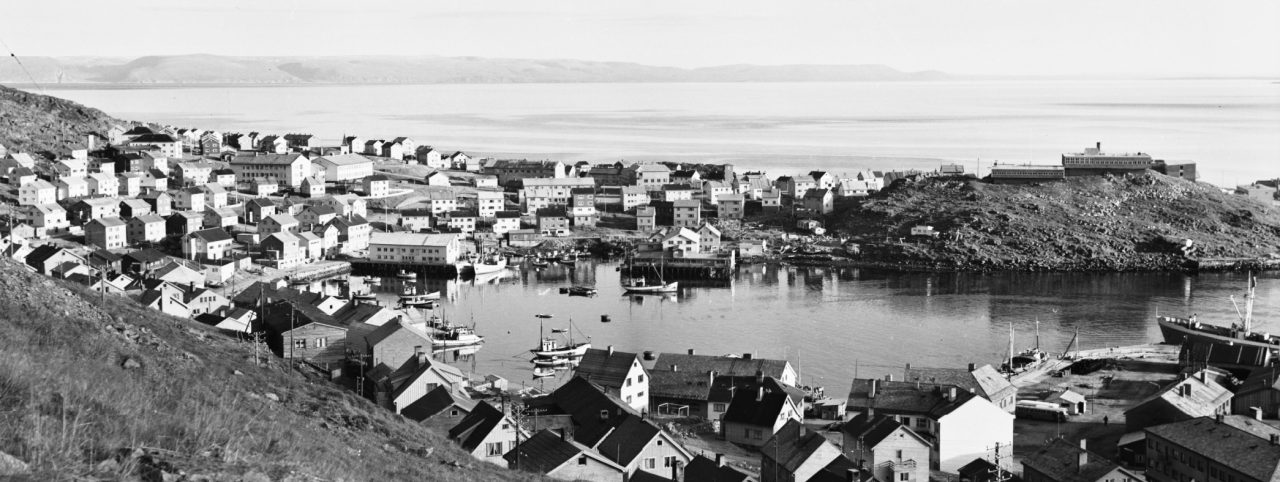
The many lumber boats that came to Honningsvåg throughout the summer for bunkering and pilotage services left their mark on the town, as did the trawlers.
Some of them came several times each summer. Those that arrived earliest could stay out in the fjord for one or two weeks to wait for permission to go east. The insurance companies, including the great Lloyds of London, I learned from someone who had been a stoker on board one of the ships that operated in this traffic, required that we had to wait until a set date.
We could hear not only the many different sounds from the whistles when they wanted a pilot on board, or to have the accompanying pilots they had been given on board in Lødingen put ashore. We heard the rattling of the chains when they let go of the large, heavy irons, or the anchors. It was a frightening sound for small children in Honningsvåg when they did not know what it was. The sound from the chains was repeated daily, all summer.
If there was no pilot available at the moment, the ships had to anchor and stay there until a pilot could be obtained. The same had to be done when there was no berth available when bunkering was needed.
That they came by, went on, or stayed there, with or without cargo, was something of a given from the time we were little and for as long as it lasted. It helped make Honningsvåg a great place to grow up.
Where did they get their cargo?
What we all knew was that they were on their way to Arkhangelsk to pick up what we called lumber. We barely heard about Onega, that it was also a city that the lumber boats went to, and that it was also in the White Sea. Where the two cities were more precisely was of less importance to most of us who saw life out on the fjord. It was usually enough to know that it was far to the east, in Russia somewhere.
What we didn’t know was that many of the large ships went much further inland into Russia. Only when the questions about the timber traffic that we no longer see anything about are raised, the question is quietly asked; Where did the timber boats go? And how did the ships dock? Someone wants to know more about what we saw.
In sources I have consulted, I find that it was not only in the port cities of Arkhangelsk and Onega that the ships picked up their cargo. Some of them passed the entrance to the White Sea and continued along the landscape of northern Russia. There were timber boats that went much further east, through the strait at Novaya Zemlya, and far beyond. They were headed for the areas where the great rivers flow.
Far up the Yenisei there is a shipping port for timber, Igarka.
 When we look at the map, we find the shipping port of Igarka at the very bottom right. Then we realize that it was a long voyage, not only far to the east, but also far to the south and inland. With the elongated island of Novaya Zemlya, as long as Norway, gives a perspective on how far the journey south went. — Photo: from the book “Through Siberia in the footsteps of the Norwegians” by Stein P. Aasheim and Nils Lund who were there in 1990.
When we look at the map, we realize that it was also a long voyage south and inland.
With the elongated island of Novaya Zemlya, at least as long as Norway, gives a perspective on how far the journey south went.
East of Novaya Zemlya
On the website of the Norwegian Maritime History Society Nordmøre, we can read about how the ship “Ekholm” around 1960 went ten hours up the great Russian river Yenisej, east of Novaya Zemlya in Russia after lumber.
 M/S Ekholm in ballast at sea – Photo from the website of the “Norwegian Maritime Historical Society of Nordmøre”
We read:
«It was a special trip when lumber was to be picked up in northeast Russia. It was a 10-hour trip up the Yenisei River, which stretches a full 4,000 kilometers from the north of Mongolia to the Kara Sea northeast of Novaya Zemlya. This cargo was going to Alexandria in Egypt.»
It was not only M/S Ekholm that made the approximately ten-hour trips up the Yenisei to Igarka. Many more than that went far into the Siberian landscape to pick up lumber. Today, all lumber shipping is carried out by Russian vessels, and Igarka is closed to foreigners.
In the 1990s, there were more than 3,000 employees at the sawmill in Igarka. The lumber is cut in the forests around Igarka, transported to the sawmills there and sawn up. Some also come by barge from other large timber companies further inland.
From the river mouth, the timber boats need about ten hours to reach Igarka. The city is not that big, but it has a cinema, a theatre and its own newspapers. — Photo: from the book “Through Siberia in the Footsteps of the Norwegians” by Stein P. Aasheim and Nils Lund who were there in 1990.
From the river mouth, the timber boats need about ten hours to reach Igarka.
Igarka, a now closed city, founded in 1929. In 1989, it had just over 18,000 inhabitants. In 2002, the population had dropped to just over 8,000. The city has an airport. – Photo: from the book “Through Siberia in the Footsteps of the Norwegians” by Stein P. Aasheim and Nils Lund. They were there in 1990.
 Material storage in Igarka, the shipping port for lumber. We see the many cargo boats that are out there in the harbor, in the great river Yevnisei. – Photo: from the book «Through Siberia in the Footsteps of the Norwegians» by Stein P. Aasheim and Nils Lund who were there in 1990.
In the book we read:
«1.2 million cubic meters of lumber are shipped out of Siberia via the harbor in Igarka during a few hectic summer months.»
Republished Thursday 25 April 2024 with source
- Aasheim, Stein P (1991) Through Siberia in the footsteps of Norwegians, Ernst G. Mortensens Forlag, Oslo
- Norwegian Maritime Historical Society Nordmøre, website https://www.skipet.no
Du må være logget inn for å legge inn en kommentar.