Several fish farms were quickly established in Honningsvåg as soon as the population had seriously started to return. It was also important for the central authorities to get the important fisheries going.
As early as 1947, Sifi, Sild- og fiskeindustri A/S, started up in Storbukt, what had been the Honningsvåg guano factory before the war. The same was true of Johan Jensen’s fish farm, which had been started up in 1924 and started up again in 1947. This was the case with several others, such as Jægtvikbruket, Eilertsenbruket and Robertsonbruket, and even Floerbruket. This was also the case with the Finotro plant, which came into being at the very beginning of the 1950s. In 1962, Norfi, Nordkapp fiskeindustri A/S, came into being, as Sifi, a factory for the production of flour and oil from guano, herring and capelin. It came into being in Kobbohola.
The problem at the beginning was getting the fish shipped south, but that was gradually resolved. As we have discussed, the government decided that a certain degree of centralization should be initiated. Not all the fishing villages that had existed in the pre-war period were to be rebuilt. Honningsvåg was the focus, but Berlevåg was considered unviable and should be closed down.
1. Eilertsenbruket
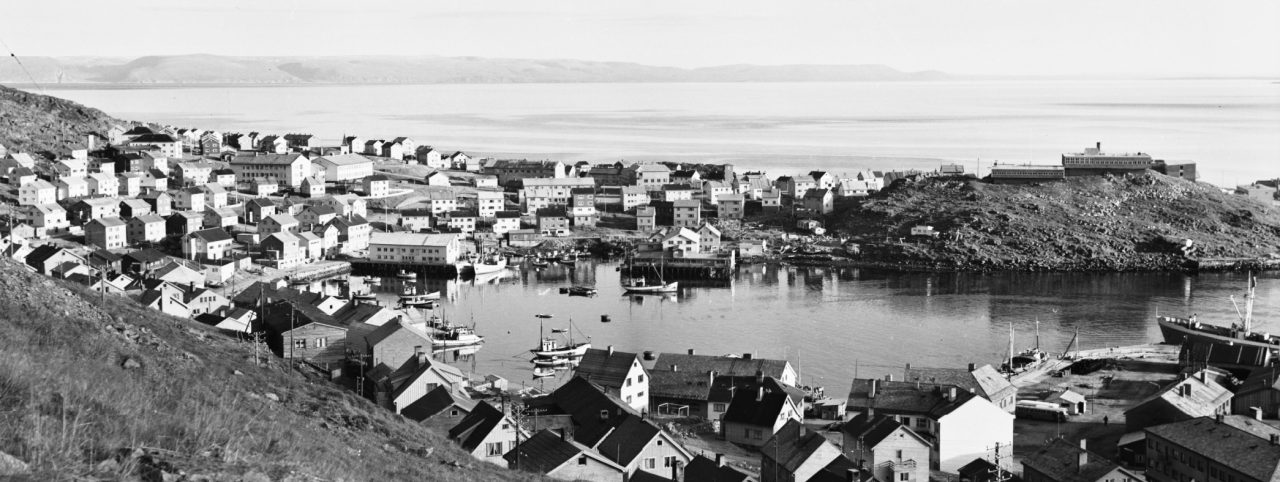
Eilertsenbruket was located at the far end of Klubben, as we can see in the picture below.
 Eliertsenbruket as it appeared until well into the 1960s.
2. Floerbruket
Anton Richar Floer had moved to Honningvåg from Breivikbotn on Sørøya already around 1920. Here he built up his fishing empire, with a department in Tyskerbrygga on Holmen. Inside Storbukt he built another department, in addition to having fish farms in a couple of other places outside Honningsvåg. As soon as the war was over, and it was possible to return, he was back in business.
In collaboration with the oil company Shell, he supplied oil to foreign trawlers, timber vessels, but occasionally also to the Norwegian Navy’s boats.
In the pre-war period, he sent out two purchasing vessels to buy up stockfish that fishermen around the small towns in West Finnmark had dried on their own shelves and baskets. In the post-war period, the M/K Saltsalen was used as a purchasing vessel for Floerbruket. With Magnus Wagelid as skipper, and Einar Johansen as dry fish wrecker, they went around to the many small towns in West Finnmark on buying trips for stockfish.
 Richard Anton Floer’s fish farm in Honningsvåg
Knut Erik Jensen joined skipper Magnus Vagelid and fish wrecker Einar Johansen on such a buying trip in the early 1970s and made a film about one of the many trips made with the vessel. The film was shown on NRK TV in 1975/76, and it should be possible to see it. They have it at the National Library, among others.
The Floer farm was closed down in 1985, after having been in operation since around 1916 when Gerhard Voldnes came there to work as a fisher, and even further back in time.
3. Jensenbruket
Johan Jensen built his fish farm in Storbukt in 1949, not far from the area where Waldemar Larsen senior had his second fish farm in the pre-war period.
At Johan Jensen’s fish farm, one of the first years after starting up, 660 tons of fish were iced, and 264 tons were salted. So much was hung that it amounted to 21 tons of dried fish. In the same year, 115 tons of cod liver oil were produced.
 This is how the Jensen factory in Honningvåg turned out — Photo from Privat
While the spring fishing was underway, Jensenbruket could have as many as 25 to 40 employees in business.
Johan Jensen sold his fish farm to A/S Finnmark and Nord-Troms fiskeindustri, Finotro, when operations there began in the early 1950s. From now on, the largest of the buildings was used as a stockfish warehouse. The transhipment plant was left unused, as were the private cabins and the tank that had been set up for the delivery of solar to the fishing fleet.
4. The Finotro plant
A/S Finnmark and Nord-Troms fiskeindustri, Finotro, came with one of the facilities in Honningsvåg in the early 1950s. It was one of the fishing villages that the authorities had decided should be targeted. It was a state-owned enterprise established by the Storting and government shortly after the war. The state owned 98% of the share capital, the Norwegian Fishmonger’s Association, the Norwegian Fishermen’s Association and the National Confederation of Trade Unions, LO owned the rest.
The head office for this organization with several fish farms on the coast of Finnmark and Nord-Troms was located here.
At the Finotro facility in Honningsvåg, fish was purchased in large quantities. Large trawlers, such as «Hans Egede» and «Kristian Tønder» regularly brought fish. Larger and smaller fishing boats from far and near delivered their catches for a number of years. Fish drying racks were built in several places on the outskirts of Honnigsvåg, and a large multi-storey rack for drying fish was built next to the plant in Storbukt.
A large number of fish products were produced, such as stockfish, salted fish, cod and saithe fillets, and there was also production of grilled fish and salmon substitutes. Halibut, tusk, catfish and haddock were purchased. Cod liver oil was steamed, bottled in large barrels, and boxes of animal feed, frozen offcuts from fillet production, were packed and shipped. Guano was also delivered in the form of fish heads for grinding for the production of fishmeal, and iced, fresh fish was regularly shipped south to Trondheim with the Hurtigruten ships.
In the spring and into the summer, Finotro also received whale meat. When whale meat arrived, production was changed, the meat was cleaned, packed and frozen. The product was sent to the markets in Norway and Europe, like all the fish.
The Finotro plant not only got more departments, but also provided many necessary jobs during the reconstruction period and for several decades beyond.
There were people working down on the pier where fish were received, processed and sent on to other departments. Fish had to be salted, fish had to be prepared for hanging on shelves, taken down again, and prepared for export. Fish and sometimes whale meat had to be sent up for processing in other departments. Here the products would be packed, sent through the freezing machines before they were sent to the cold stores. There were special people who took care of the machinery that kept the cold stores in operation and we had the administration that managed the whole thing.
And we could constantly see the large ships, the cargo ships, that came to the Finotro plant and picked up frozen fish products.
Before construction of the Finotro facility could begin, a newly built, private fish farm that had already arrived was removed.
 A/S Finnmark and Nord-Troms fishing industry, Finotro in Honningsvåg seen from Richard Anton Floer’s fish farm in Storbukt
Finotro was in operation from 1952 to 1982, writes Harald Vik in the book «FINOTRO A/S 1952-82. Finotro was established on the recommendation of the Ministry of Fisheries, by a resolution in the Storting on March 31, 1950, he says. Harald Vik was managing director from 1954 to 1977.
Not only was fish purchased for hanging and salting, but fillets were produced on a large scale for the foreign market, sold through the organization Frionor. When the plant was expanded in the early 1960s, it also began producing manufactured fish sticks and so-called salmon substitutes. Almost all types of fish were purchased, such as cod, saithe, haddock, tusk and halibut, and occasionally redfish, but only if large enough quantities arrived. If whale meat arrived, production was changed and whale meat was packaged until there was no more left.
In the 1960s, the two large stern trawlers «Hans Egede» and «Kristian Tønder» fished for the Finotro facility.
 Large cargo ships, such as the sister ships «Torfinn Jarl» and «Sote Jarl», continued to arrive, loading frozen fish for the large markets «out in Europe».
Loads of fresh, iced fish were constantly being shipped out to Vågen for shipment to Trondheim and Bergen with the Hurtigruten ships. Finotro, Finnmark and Nord-Troms fishing industry was sold to Frionor, Norsk frossenfisk A/S and then closed down in 1990.
5. Jægtvikbruket
Gudmund Jægtvik returned when the evacuation period was over and got started. He continued in his father’s footsteps and built up his fish farm where they had had one until the summer of 1942.
Inside and between the rocks in Nordmanset he had the shelves and the hesjene where the fish was dried, as both Finotro and Robertsonbruket also had. In the spring, fresh, barred and «raw-cut» fish was transported inland to the shelves. In the summer, the fish were picked off and loaded onto the truck bed. Edmund Jørgensen drove the truck throughout the post-war period, as long as the farm was in operation.
In 1962/63, Mobil Oil came and built two large oil tanks in connection with the fish farm, and Jægtvik gained an expanded work area and greater earnings.
In the last years that the farm was in operation, he purchased a small freight boat. With it, he transported fish inland to Lafjord for hanging, instead of inland to Nordmanset.
 The Jægtvik farm as it looked until it was demolished, after a fire in the late 1960s.
In an advertisement in Vestfinmarken we could read:
«Bank and bank fishermen I buy all kinds of fish for icing, salting and hanging. Gudmund P. Gjægtvik»
In recent years, Jægtvik bought fish, brought it inland to Lafjord with his own boat. Here it was hung on a rack to dry.
Then it happened that even before 1967, Gudmund Gjægtvik had closed down his fish farm. His ancestors were from Trøndelag, and when the company in Honningsvåg was closed down around 1966-67, he moved there with his family. There he started salmon farming, he said, and it was mentioned in an article in Finmarksposten at the time, we remember.
6. Robertson Farm
The Robertson Farm in Honningsvåg also got started quickly after the war. As we remember, it was Georg Robertson, the Englishman who came and settled in Hammerfest who also established himself in Honningsvåg. His son Charles Robertson eventually took over and continued to run the business until 1958.
 The Robertson farm in Honningsvåg as it appeared around 1960
7. Sild og fiskeindustri A/S — Sifi
After a period of waiting, the 1990 season at Sifi, Sild og fiskeindustri a/s, started up again, but it did not go well, so it was the last. The following year it was over. There was not enough raw material to get hold of, the state had no more subsidies to assist with, and the owners did not see the benefit of investing. The factory, which was built in 1947, went bankrupt in 1991.
 Sild og fiskeindustri A/S — Sifi, or in English, Herring and fishing industry A/S — Sifi, beyond Ricard Floer’s fish farm
We learned that the processing machinery had been removed and we saw that the department where production took place was destroyed.
8. Nordkapp fiskeindustri A/S — Norfi
Nordkapp fiskeindustri A/S, had been built up around 1961, by the company Odd Berg in Tromsø. The silo came ten years later, and was completed in 1972. This fishing enterprise is also out of business, it was closed down in 1986, and dismantled the following year. The factory was then razed to the ground. Apart from the quay, all that remains is the flour warehouse and the flour silo, and a small office and welfare building used by those who were responsible for the delivery of bunker oil, coal and salt.
 We see Nordkapp fiskeindustri A/S in a photo taken in the late 1960s — Photo from Terje Cock Svane
Honningsvåg thus became an important fishing village in Coastal Finnmark. The Hurtigruten ships came by daily. Several local liners had Honningsvåg as their starting point, and there was a lot of activity at Damskipskaia with loading and unloading. It was not only the large cargo liners that came and loaded frozen fish and fish products with courses for Norwegian and foreign ports. Tankers came to the herring oil factories and had their tanks filled with oil from herring and capelin production, just as larger vessels came and loaded feed in the form of meal from guano, herring and capelin.
At both fishmeal and fish oil factories, life came to life in the post-Christmas winter. Then the capelin fishing started, and all the purse seiners and capelin trawlers were here and filled the fjord with capelin purse seiners and capelin trawlers. It created life out on the fjord, and life in Vågen with fishermen who came on a city tour in their light boats while the vessels were unloaded. The same was true during the herring fishing in the summers. Larger and smaller vessels came loaded with herring inland to Storbukt where Sifi received the catches, and to Norfi in Kobbhola. There was even more life than there had been in the period between the two seasons with the pollock and herring fishing.
But then things changed
The many smaller fish farms that were built up after the war did not remain in operation for more than a couple of decades. The Eilertsen farm out at Klubben was only operated for a short time, then it remained there for a few years before it was bought up by others and converted into a so-called seiner. Gudmund Jægtvik, who had rebuilt the facility early in the post-war period, closed it down around 1970. At about the same time, the Floer farm was closed down.
When A/S Finnmark and Nord-Troms fiskeindustri’s plant, Finotro, came, some of the other plants were closed down, such as the fish farm that was first where Finotro came. Jensenbruket at the bottom of Storbukt was very well run for a few years in the post-war period. It was taken over by Finotro and used as a warehouse for stockfish.
All together, every single one of the fish farms that came in the post-war period has either been closed down, demolished and removed, such as Jægtvikbruket, and Floerbruket. Or they have been sold, as have Robertsonbruket in Vågen and Eilertsenbruket. Robertsonbruket was taken over by the Bergen firm Clemet Johnsen and operated effectively for a few years, until Finotro took it over.
The herring oil and herring meal factories went the same way. Sild og fiskeindustri a/s in Storbukt, Sifi, and Nordkapp fiskeindustri a/s, Norfi in Kobbhola were gone. One was allowed to go bankrupt. The other was closed down and the factory department was removed. There was a shortage of raw materials.
Finotro was taken over by Frionor in 1986, and went bankrupt in 1990. A new government had come into power, the Labour Party had lost power and the new government was not to have state-owned fishing companies.
Then one summer day when people in Storbukt woke up, they could hear the sound of a machine knocking the largest of the buildings to pieces. And when the rest of us passed by, we saw that the Finotro plant was being crushed. The building where the dried fish was stored, and the one where the fish was salted, were demolished. and the fish shed. The building where the private cabins were, and the net shed, were both burned down along with the wooden quay.
Unemployment and eviction
The many employees at the plants were laid off. The result was what we saw, the workers noticed, the municipality felt the tax revenue, and the then employment office, and the social welfare office experienced when the demands for unemployment benefits and other benefits came. Many were forced to find work elsewhere and move away from here. The decline in the population began.
The daily flow of workers through Storbukt and down to Finotro stopped completely. Everyone who had flowed through Løkkebukta and inland to the plant in Storbukt every morning was gone. The bus from Nordvågen with workers to the salmon substitute production department did not arrive.
The fishing boats and trawlers did not arrive anymore.

A small part of the large Finotro facility is shown here. Photo: Terje Cock Svane
All of the fishing industry had been closed
Everything that had been built up by the fishing industry in Honningsvåg had been closed. All eight of the Honningsvåg fishing industry facilities that had been closed were also gradually removed, completely.
What had happened?
The nets had become larger and better equipped. With echo sounders and ASDIC, it was no problem to locate the shoals of herring and capelin. With a power unit, the net could be hauled in when the shoals were surrounded and the nets emptied. Fishing became more efficient, not as many men were needed to do the job, and the quantity caught grew larger year by year. The result was that both the North Atlantic capelin and herring stocks virtually collapsed. When the capelin almost completely disappeared, the rich cod fisheries disappeared. The same thing happened with the herring.
When the capelin, with its accompanying schools of cod, were supposed to have come in large numbers from the Barents Sea and towards the Finnmark coast, but did not, it was no longer profitable to use longlines. There was a long period of shortage of fish, and incomes fell. Regulations in the form of quotas were introduced.
Herring oil and herring meal factories were closed down, not only in Honningsvåg, but also in Øksfjord and Vadsø, among others. It was no longer profitable to keep them running due to a lack of raw materials. The little that was caught went to the factories further south in the country.
The other fishing villages
People began to wonder what was happening. Or, perhaps it was only after everything had run its course that the wonder came? Why had it happened like this? Foreign tourists asked the question: What do people do for a living? What should we answer? That was when I, who am writing this, began to think about the matter.
Did the fish farms in Nordvågen, Kamøyvær, Skarsvåg and Gjesvær continue to operate as before, and still do? It was the fishing village of Honningsvåg, the fishing village that is the topic here, that went downhill.
The answers to the question
After working hard to get money to modernize operations at the Finotro plant, which was going to require expensive investments, the government decided that we should not have state-run fishing enterprises. That was when Finotro was sold to Frionor frozen fish A/S.
Why was the newly acquired plant sold to Frionor and then closed down? Were there problems getting enough fish for production? That remains to be found, but that could be one explanation.
The answer to why the fish farms and the important fishing village have gone the way they have is something I have been trying to find out. And the answers have been found to a large extent. We have them, at least enough to see the drawing.
Restructuring
What was once the large fishing village of West Finnmark, both before the war and in the post-war period, is no longer there. Why?
When there was talk of modernising the Finotro plant in Honningsvåg, the answer from the government we had at the time was that we should not have state-run fishing industry plants. We know how it went with the many fish farms in Vardø, and with Findus in Hammerfest. It went the same way, through the acquisition of plants and the buying and selling of quotas.
Quotas were introduced where each fishing vessel and its owner had to stay within the allocated amount of fish. No sooner had that happened than what had to come came, the buying and selling of quotas.
The answer we come up with is restructuring, here as in other areas, including acquisitions and closures, and the fact that acquired fish farms such as Jensenbruket and Robertsonbruket are joining the drag
All the fishing industry had been closed down
Everything that had been built up by the fishing industry in Honningsvåg had been closed down. All eight fishing industry plants that Honningsvåg had had were closed down and gradually removed completely.
Then came Storbukt Fiskeindustri A/S, Stofi, as the 9th fish farm. It was in 1991. Stofi is located where the large Finotro plant had been. Stofi A/S is now the only fish farm in Honningsvåg, and operates on a smaller scale than Finotro. In return, they also deal in crabs, in addition to fresh fish, stockfish and salted fish.
 Cape Fish A/S with Stofi, Storbukt Fiskeindustri A/S which came along in 1991 – Photo: Terje Cock Svane
This is how Honningsvåg, what had once been West Finnmark’s large fishing village, was transformed into something completely different from what it had been.
Updated Sunday August 9, 2026 – 11:56 PM with sources
- Richter Hansen, Einar (1990) NORDKAPP en fiskerikommune fra de eldste tider til i dag, Nordkapp kommune, Honningsvåg
- Richter Hansen, Einar (1990-91) «Fiskeriene – Finnmarks hovednæring», Årbok for Nordkapp 1990-91, Honningsvåg
- Eriksen, Steinar (2013) «Honningsvågminner» i Samhold gjør sterk, 100 år i bilder og tekst, Honningsvåg Handel- og Industriforening, Honningsvåg
- Botolfsen, Øystein (1990) Finnmark fylkeskommunes historie, Vadsø municipality, Vadsø
 Richard Anton Floers fiskebruk inne i Storbukt – Foto: Kåre M. Hansen
 Johan Jensens fiskebruk inne i Storbukt, slik det tok seg ut i 1950 og 1960-årene – Foto: i priavat eie.
 A/S Finnmark og Nord-Troms fiskeindustri, Finotro på et bilde tatt i 1950-årene. Foto: Mittet / Nasjonalbiblioteket
 Jægtvikbruket slik det tok seg ut frem til det ble revet, etter en brann i slutten av 1960-årene.
 Robertsonbruket slik det tok seg ut i tida omkring 1960
 Foruten kaia er det eneste som står igjen, mellagret og melsiloen, og et lite kontor- og et velferdsbygg brukt av dem som stod for levering av bunkrsolje, kull og salt. Vi ser havøysundsnurperen MS Hugo Trygvason ved Nordfikaia en gang i 1960-årene. — Foto fra Finmarksposten
Du må være logget inn for å legge inn en kommentar.