In English & In Norwegian
Kjelvik has been a church and trading post for several hundred years. As early as 1589, Kjelvik was the centre of a parish with three churches. The main church was in Kjelvik. There were annex churches at Helnes and out at Opnan.
Olaf Simonsen, who grew up in Kjelvik, wrote in Vestfinmarken in 1930 about Kjelvik. In one place he writes about how much and what was exported from the trading post Kjelvik between 1765 and 1788, and lists fish products, goat skins, reindeer horns and bird feathers. It is a time of decline that he is writing about and we read:
«At that time, the common people of Kjelvik county, along with the Finns in Porsangerfjorden, were placed under this trading post, which in recent times has not been of particular importance.»
We can understand this when we see how few people lived there then, and when we also know that people moved around.
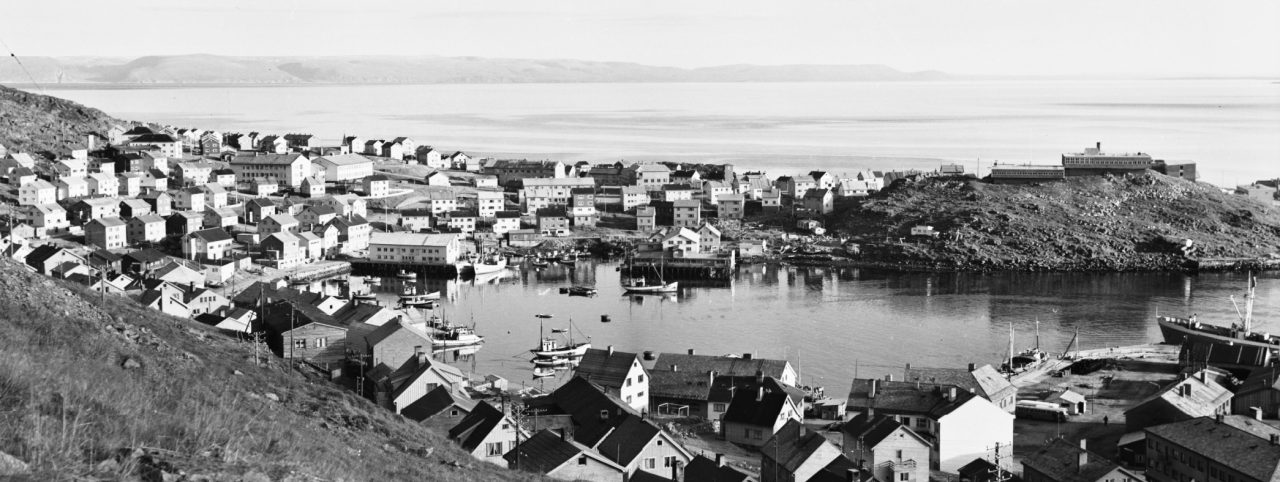
Kjelvik as it looked from the footpath between Nordvågen and Kjelvik, when Elisabeth Meier went there during the war, in the summer of 1941.
BILDET
Road construction in the municipal center of Kjelvik In 1907, the population of Kjelvik had applied for a road in the fishing village, which had now become a municipal center. As many as 1,000 people could live in Kjelvik during the spring cod fishing at this time. When it rained and the snow melted, the water came trickling down from the surrounding mountains and turned the entire area people moved around into a dissolved mud. The road inside Kjelvik was begun in 1912, with a grant of 8,500 kroner from the county council, and was completed in 1913. Culverts were also laid under the road to drain the water.
From further back we know that the fishing village and church site Kjelvik has had a varying number of residents throughout the ages. The population peaked around 1690, with close to 60 households. With little and big, almost 300 people lived in the fishing village. People moved on, and in 1717, says Thomas von Westen, there were only a couple of poor fishing families left, but the church, that was it then too.
A smallpox epidemic came to the areas of Midt-Finnmark around 1760, and many also died in the fishing village of Kjelvik while it was going on. Nevertheless, the population had increased, for there were 85 residents here in 1769. When we come to 1801, and there were, as is stated, 7,701 inhabitants in all of Finnmark – or as is also mentioned, just under eight thousand, the population in the fishing village, at the church site and in the centre of the annexed parish of Kjelvik had again shrunk. Now there were no more than 38 permanent residents to be found, and it was constantly decreasing. It decreased so much that in 1825 there were only 14 left.
At the census in 1900 it was found that there was an increase in the population, as the number of residents had again increased, now to 114.
We learn about Olaf Simonsen, who had grown up in Kjelvik around 1875, in what he wrote in «Vestfinmarken» on 9 October 1930. He says that after reviewing written and unwritten sources, he will give a small description of the older church buildings in Kjelvik. He writes:
«Since ancient times, the fishing village of Kjelvik has been known as a church and trading place.» and that «In 1589, Kjelvik was its own parish with three churches: namely the main church in Kjelvik and annex churches in Opnan and Helnes (Helganes), later annex churches were also built in Måsøy, Skarsvåg and Sværholt.» And further that «In 1593 it is reported that the parish included the following places: Kjelvik – Honningsvåg – Altsula – Ballhopen and Sværholt. Opnan and Helnes were then added to Tune’s parish.»
We ourselves see that it was a different life they lived than we do. And they moved from the coast to the inland, somewhat depending on how the fishing was. Many drowned at sea, sailing with the small boats with sails, instead of engines. And people kept coming north when times were bad further south.
Published with the sources…