5. Reindriftssamene

Norsk & In English

Reindriftsamene vi møtte, i Honningsvåg, og omkring på Magerøya, som i Gullgammen og i Finnvika, det er mennesker med røtter tilbake i århundredene. Deres forfedre og formødre har levd sine liv her oppe i nord åtet rundt, med bitende kulde inne på vidda og midnattsola sommeren igjennom.

Reindriftsamer har hatt tilhold ute ved kysten og mest sannsynlig også på Magerøya så lenge det har vært tamreindrift på Nordkalotten, og det begynner å bli lenge. Det var på 1600 tallet man begynte med tamreindrift, kan vi lese i historiebøkene. Gjennom århundrene har samene om våren fulgt reinflokken fra vidda og utover til kysten. Her har de holdt til somrene igjennom.

Den gang da bildet ble tatt, var det noe som ble kalt Reinskue, og da kom turistene fra nordgående hurtigrute med buss innover til Nordmanset, et par kilometer utenfor Honningsvåg.

Samer vi møtte i Honningsvåg i etterkrigstida, folk som i sommerhavåret gjennom generasjoner, ja helt fra 1600-tallet, har fulgt reinflokkene sine inne fra Finnmarksvidda og ut hit.

Vi som vokste opp i den tida, var kan hende alle der inne for å se sameleiren, samene med et av de mange reinsdyrene, og ikke minst alle turistene. Reinskuet i Nordmanset ble nedlagt i tida omkring 1965, men vi møtte de mange karasjoksamene til daglig også i byen. Så vi som har hatt vår oppvekst i Honningsvåg, kan kjenner igjen hver eneste en av dem vi ser på bildet fra den gang.

Høst og vår, før vei ble bygd, var hele familier på vandring mens det i dag vel bare er en del av familiene som flytter med flokken

Da utviklinga gjorde at det ikke lenger var mulig å ha tilhold i Nordmanset, ble alternativet å trekke opp på fjellet. Her fortsette der. Så i dag, møter turistene samer med sine utsalg og den reinen de har med, der.

Den flokken som har kommet over til Magerøya, har svømt over Magerøysundet, slik andre flokker har svømt over andre sund. Når høsten har kommet, har de brutt de opp og fulgt flokken innover mot vinterbeitene, der Karasjok er sentrum, og der familiene har holdt til i gjennom vinterhalvåret.

Over Magerøysundet svømte karasjoksamenes reinflokker. Det gjorde de vår som høst, år etter år, helt fra reindriftsamene gikk over til å bli nomader på 1600-tallet, og frem til et par tre ti-år etter krigen. Da ble det slutt, for da av begynte forsvarets landgangsfartøyer å frakte reinflokken over.

Her svømmer reinflokken over Magerøysundet — Foto: Aune kortforlag

Reinsvømminga over Mageøysundet, noe som kan hende har pågått gjennom flere hundre år. Store og små skip, og fiskefartøyer i allestørrelser har i lange tider søkt seg innenskjærs på vei både nordover og sørover og dermed tatt veien gjennom Magerøysundet.

Samefolket

Samene vi møtte i Honningsvåg i etterkrigstiden, er folk som i sommerhalvåret gjennom generasjoner, helt siden 1600-tallet, har fulgt reinflokkene sine fra Finnmarksvidda og ut hit. De har sine røtter i de nordlige områdene gjennom århundrer, om ikke årtusener, tilbake.

Deres forfedre og formødre har levd sine liv i det vi kan kalle Sapmi, her hvor midnattsola skinner sommeren igjennom, og mørketida ubønnhørlig kommer et stykke ut på vinteren og varer i et par måneder.

Sapmi, området der samekulturen i løpet av de to til tre siste tusen årene har utviklet seg, blir av samer gjerne omtalt som Sapmi. På de store viddene har den samiske kulturen med sine språk, sin religion, og sin levemåte som nomader utviklet seg uten større påvirkning fra folk lenger sør.

Finnmǫrk var den norrøne befolkningas navn på de store områdene i Norden som ble ansett å ligge utenfor deres hjemområder, og der det i all hovedsak bodde samer.

På kartet finner vi både Finnmǫrk, Magerey, på samisk Makaravjo. — Et kart fra Wikimedia Comons

Med folk utenfor har det blitt drevet handel, kanskje mest i fredelige former. Med sin levmåte under andre forhold enn folk lenger sør, og dermed under vilkår forskjellig fra folk omkring, har de levd med sine egne språk, og med sine egne religiøse forståelser av tilværelsen.mSamtidig har de gjennom sin kontakt med omverdenen sett og erfart det, og oppfattet seg som annerledes, som samer. Identiteten deres har vært en annen, en identitet vi betegner som samisk.

Etter at nord-norske stormenn eller høvdinger helt fra 900-tallet begynte å interessere seg for landområdene, ble det sendt skatteoppkrevere inn i områdene. Både norske og svenske utsendinger, og utsendinger fra fyrsten i Novgorod kom hit som skatteoppkrevere. Formålet ble etter hvert å å få underlagt seg områdene. De som ble avkrevd skatt, ble ansett som beboere i skattoppkrevernes landområde.

Områdene der samene har holdt til, i Sapmi, har blitt delt opp og  bunderlagt Norge, Sverige og Russland, og fra 1917 også Finland.

Publisert med kildene

  • Eriksen, Thomas Hylland, (2013) Fredrik Barth, Universitetsforlaget, Oslo
  • Barth, Fredrik, red. (1969) Ethnic Groups and Boundaries, The Social Organization of Culture Difference, Universitetsforlaget, Oslo
  • Eidheim, Harald (1969) When Ethnic Identity is a Social Stigma, in Barth, Fredrik, red. (1969) Ethnic Groups and Boundaries, The Social Organization of Culture Difference, Universitetsforlaget, Oslo
  • Richter Hansen, Einar (1990) NORDKAPP en fiskerikommune fra de eldste tider til i dag, Nordkapp kommune 1990, Honningsvåg
HOME DBL BACK

The reindeer herding Sami we met

In English & På norsk

The reindeer herding Sami we met, in Honningsvåg, and around Magerøya, as in Gullgammen and in Finnvika, are people with roots going back centuries. Their ancestors and foremothers have lived their lives up here in the north, grazing around, with the biting cold on the plateau and the midnight sun all summer long.

Reindeer herding Sami have lived out on the coast and most likely also on Magerøya as long as there has been domesticated reindeer herding on the North Calotte, and that is starting to be a long time. It was in the 17th century that domesticated reindeer herding began, we can read in the history books. Over the centuries, the Sami have followed the reindeer herd from the plateau and out to the coast in the spring. Here they have stayed all summer long.

At the time the picture was taken, there was something called Reinskue, and then the tourists from the northbound Hurtigruten came by bus inland to Nordmanset, a couple of kilometers outside Honningsvåg.

Reindeer herding Sami on Magerøya around 1960

We who grew up at that time were probably all there to see the Sami camp, the Sami with one of the many reindeer, and not least all the tourists. The reindeer herding in Nordmanset was closed down around 1965, but we met the many Karasjok Sami on a daily basis in the city as well. So those of us who grew up in Honningsvåg can recognize every single one of them we see in the picture from that time.

In the fall and spring, before the road was built, entire families were on the move, while today only a portion of the families move with the herd
When development made it no longer possible to stay in Nordmanset, the alternative was to move up into the mountains. Here we continue there. So today, tourists meet the Sami with their stalls and the reindeer they have brought with them, there.

The herd that has come over to Magerøya has swum across the Magerøy Strait, just as other herds have swum across other straits. When autumn has come, they have broken up and followed the herd inland towards the winter pastures, where Karasjok is the center, and where the families have lived throughout the winter months.

Here the reindeer herd swims across Magerøysundet — Photo: Aune kortforlag

The Karasjok Sami reindeer herds swum across the Magerøy Strait. They did this in spring and autumn, year after year, ever since the reindeer herding Sami became nomads in the 17th century, and until a couple of decades after the war. Then it ended, because from then on the military’s landing craft began to transport the reindeer herd across.

Reindeer swimming across the Mageøy Strait, something that may have been going on for several hundred years. Large and small ships, and fishing vessels of all sizes, have long sought their way into the fjords on their way both north and south, thus making their way through Magerøysundet.

Reindeer swimming across the Mageøysundet, which may have been going on for several hundred years. Large and small ships, and fishing vessels of all sizes, have long sought their way into the inlet on their way both north and south, thus making their way through the Magerøysundet.

The Sami people

The Sami people we met in Honningsvåg in the post-war period, people who in the summer sea year through generations, even since the 17th century, have followed their reindeer herds from the Finnmark plateau and out here. They have their roots in the northern regions back centuries, if not millennia.

Their ancestors and foremothers have lived their lives in what we can call Sapmi, here where the midnight sun shines through the summer, and the dark time inexorably comes a little way out in the winter and lasts for a couple of months.

Sapmi, the area where Sámi culture has developed over the past two to three thousand years, is often referred to by Sámi as Sapmi. On the vast plains, Sámi culture, with its language, religion, and nomadic way of life, has developed without much influence from people further south.

Finnmǫrk was the Norse population’s name for the large areas in the Nordic region that were considered to lie outside their homelands, and where the Sámi people lived in the main.

On the map we find both Finnmǫrk, Magerey, and in Sámi Makaravjo. — A map from Wikimedia Commons

Trade has been conducted with people outside, perhaps mostly in peaceful forms. With their way of life under different conditions than people further south, and thus under conditions different from the people around them, they have lived with their own language, and with their own religious understandings of existence.

At the same time, through their contact with the outside world, they have seen and experienced it, and perceived themselves as different, as Sami. Their identity has been different, an identity we refer to as Sami.

After northern Norwegian nobles or chieftains from the 9th century began to take an interest in the lands, tax collectors were sent into the areas. Both Norwegian and Swedish envoys, and envoys from the prince of Novgorod came here as tax collectors. The purpose eventually became to subjugate the areas. Those who were taxed were considered residents of the tax collectors’ land area.

The areas where the Sami have lived, in Sapmi, have been divided up and subsumed into Norway, Sweden and Russia, and from 1917 also Finland.

Published with sources

  1. Eriksen, Thomas Hylland, (2013) Fredrik Barth, Universitetsforlaget, Oslo
    Barth, Fredrik, ed. (1969) Ethnic Groups and Boundaries, The Social Organization of Culture Difference, Universitetsforlaget, Oslo
  2. Eidheim, Harald (1969) «When Ethnic Identity is a Social Stigma», in Barth, Fredrik, ed. (1969) Ethnic Groups and Boundaries, The Social Organization of Culture Difference, Universitetsforlaget, Oslo
  3. Richter Hansen, Einar (1990) NORDKAPP en fiskerskommune fra de eldste tider til i dag, Nordkapp kommune 1990, Honningsvåg
HOME DBL BACK

Nordkapp Municipality, an Introduction

In English & På norsk

The History of Nortkapp Municipality has its origins in curiosity. It really started when German tourists I got into conversation with asked what people did for a living in Honningsvåg. It was while I was still living and working in the city. Then I started to look around in a different way. I started to think back to what had been.

Those of us who grew up in the post-war period remember the heavy traffic out on the fjord. What about it? Why had it become so quiet out there? The foreign trawlers, of which there had been so many year-round, had disappeared, and that overnight. There were no more timber boats on their way to or from Russia. The many tank farms had been left without large and small oil tankers. Of the many oil tank farms, only one was left. The others had been removed.

One day I saw that they were destroying the large Finotro plant. New questions arose. Why had so much of the business community in the fishing village and port city of Honningsvåg declined so sharply? Why were all the fish farms gone? There was no longer any smoke coming from the herring oil and herring meal factories. Both had been shut down for good. At that time, one of them had been partially destroyed, the other completely removed. And now, in 2023, the other has also been destroyed. In June, only ruins remain of Sifi, an industrial enterprise that was there from the early post-war period.

Here we see Honningsvåg School, the first school building that came, in 1896, and the new school behind it, which came in 1929. They came up right next to the church, you see. The picture was taken after 1939, when the Inland Seamen’s Mission’s fisherman’s home had come up, just below the school buildings.

It didn’t stop there. How has development progressed in Honningsvåg, and in the municipality from ancient times until the burning? What was it like during the war, and during the evacuation period? And what about the evacuation that so many of us had heard about, but most of us saw terribly little about. The background to the burning and evacuation in 1944, and the connection it had with what happened east of Finnmark and North Troms, has also been largely unknown.

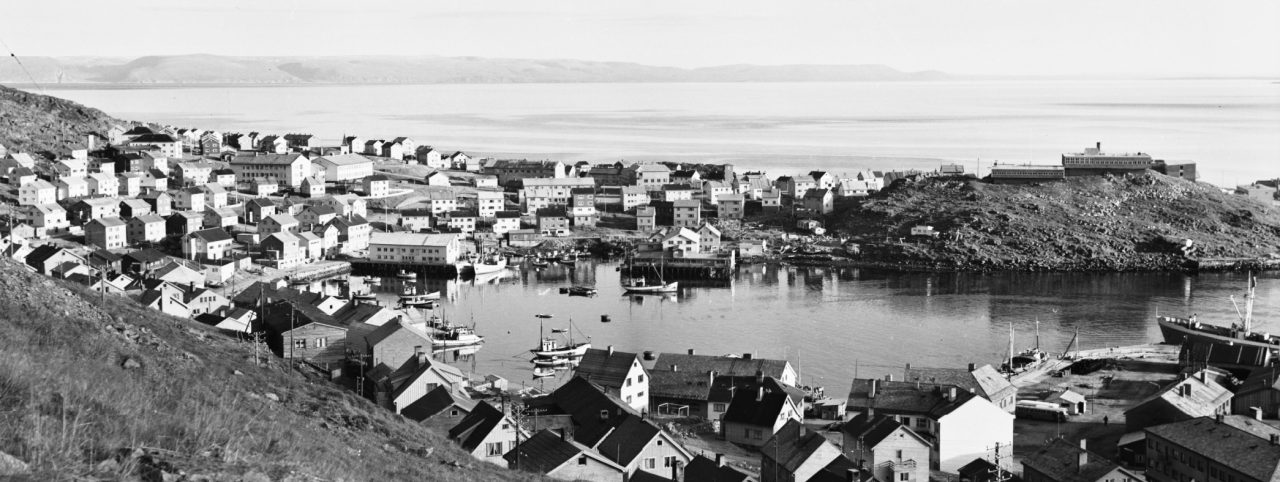
This is Honningsvåg shortly before the 1944 fire, a photo taken after 1939 when the Inland Seamen’s Mission’s fisherman’s home had arrived and was built where there had previously been a fish farm.

It is possible to find out a great deal. We have the literature, among other things. It has now been more than thirty years since important books about Finnmark were published, such as Øystein Bottolfsen’s «History of Finnmark County Municipality 1840-1990», Einar Richter Hansen’s «Nordkapp. A fishing municipality from the earliest times to the present day», Randi Rønning Balsvik’s «Vardø. Border post and fishing village» and Reidar Hirsti’s anthology «Finnmark». We also have the film series «Norway between East and West» with Knut Erik Jensen as director, and not least, the yearbooks from the history societies, such as those published by the North Cape Museum in collaboration with the North Cape History Society since 1982. And we have the National Library with newspapers from the past, books and pictures.

This provides the basis for being able to write about the municipality that was established in 1861 with only 300 inhabitants and which was named North Cape on July 8, 1949, and about the county of Finnmark which was named Finnmark county in 1919. The sparsely populated area had become part of Norway, a separate county that so many of us have known so little about for so long.

Local history is communication and documentation. It is part of preserving cultural heritage. With insight into that too, we can better reflect on who we are and where we are headed. Knowledge of the past is an important part of our cultural development and formation, and is important both for the individual, for the local community, as well as for Norway’s national identity. At the same time, knowledge of local history helps to provide an anchoring in the local, something that contributes when we are going to build our identity. Sidsel Hindal writes that «One of the most important functions is precisely identity creation, with documentation and contribution to democracy as the other two.»

Then we have important enough reasons to be able to justify that this local history has been started. It is also the case that most of what comes here is scattered in the literature that has been found, in order to then have it written down and perhaps get important historical knowledge in print, collected and made available, for the benefit of us all as we begin to search back to the past of our regions.

The website was created in 2016. It is not a scientific thesis, because it does not ask a question that interests me particularly, and that I seek an answer to, and then publish it so that researchers can take the result into account. It is mostly about finding out, getting to know it, popularizing it, and then making it available with a view to a general audience and so that schoolchildren can benefit from it.

It has also been said that «Without the narrator, the past dies» and that «Knowledge changes everything.» Both of these provide justifications for what is designed and arranged here.

Updated March 9, 2026 and translated into English on Wednesday, August 12, 2026

HOME