In English & På norsk
The History of Nortkapp Municipality has its origins in curiosity. It really started when German tourists I got into conversation with asked what people did for a living in Honningsvåg. It was while I was still living and working in the city. Then I started to look around in a different way. I started to think back to what had been.
Those of us who grew up in the post-war period remember the heavy traffic out on the fjord. What about it? Why had it become so quiet out there? The foreign trawlers, of which there had been so many year-round, had disappeared, and that overnight. There were no more timber boats on their way to or from Russia. The many tank farms had been left without large and small oil tankers. Of the many oil tank farms, only one was left. The others had been removed.
One day I saw that they were destroying the large Finotro plant. New questions arose. Why had so much of the business community in the fishing village and port city of Honningsvåg declined so sharply? Why were all the fish farms gone? There was no longer any smoke coming from the herring oil and herring meal factories. Both had been shut down for good. At that time, one of them had been partially destroyed, the other completely removed. And now, in 2023, the other has also been destroyed. In June, only ruins remain of Sifi, an industrial enterprise that was there from the early post-war period.
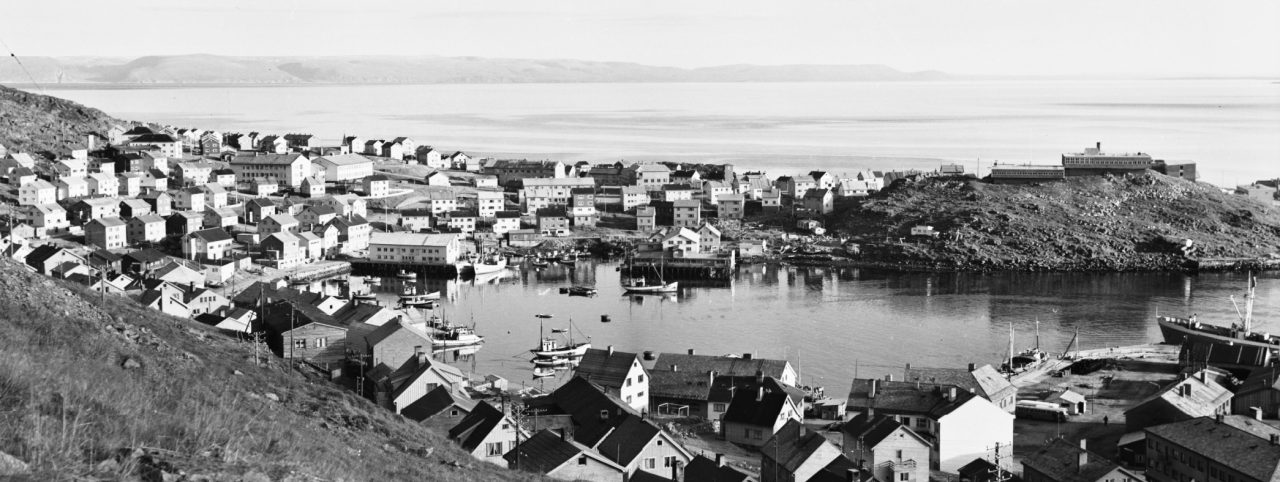
 Here we see Honningsvåg School, the first school building that came, in 1896, and the new school behind it, which came in 1929. They came up right next to the church, you see. The picture was taken after 1939, when the Inland Seamen’s Mission’s fisherman’s home had come up, just below the school buildings.
It didn’t stop there. How has development progressed in Honningsvåg, and in the municipality from ancient times until the burning? What was it like during the war, and during the evacuation period? And what about the evacuation that so many of us had heard about, but most of us saw terribly little about. The background to the burning and evacuation in 1944, and the connection it had with what happened east of Finnmark and North Troms, has also been largely unknown.
This is Honningsvåg shortly before the 1944 fire, a photo taken after 1939 when the Inland Seamen’s Mission’s fisherman’s home had arrived and was built where there had previously been a fish farm.
It is possible to find out a great deal. We have the literature, among other things. It has now been more than thirty years since important books about Finnmark were published, such as Øystein Bottolfsen’s «History of Finnmark County Municipality 1840-1990», Einar Richter Hansen’s «Nordkapp. A fishing municipality from the earliest times to the present day», Randi Rønning Balsvik’s «Vardø. Border post and fishing village» and Reidar Hirsti’s anthology «Finnmark». We also have the film series «Norway between East and West» with Knut Erik Jensen as director, and not least, the yearbooks from the history societies, such as those published by the North Cape Museum in collaboration with the North Cape History Society since 1982. And we have the National Library with newspapers from the past, books and pictures.
This provides the basis for being able to write about the municipality that was established in 1861 with only 300 inhabitants and which was named North Cape on July 8, 1949, and about the county of Finnmark which was named Finnmark county in 1919. The sparsely populated area had become part of Norway, a separate county that so many of us have known so little about for so long.
Local history is communication and documentation. It is part of preserving cultural heritage. With insight into that too, we can better reflect on who we are and where we are headed. Knowledge of the past is an important part of our cultural development and formation, and is important both for the individual, for the local community, as well as for Norway’s national identity. At the same time, knowledge of local history helps to provide an anchoring in the local, something that contributes when we are going to build our identity. Sidsel Hindal writes that «One of the most important functions is precisely identity creation, with documentation and contribution to democracy as the other two.»
Then we have important enough reasons to be able to justify that this local history has been started. It is also the case that most of what comes here is scattered in the literature that has been found, in order to then have it written down and perhaps get important historical knowledge in print, collected and made available, for the benefit of us all as we begin to search back to the past of our regions.
The website was created in 2016. It is not a scientific thesis, because it does not ask a question that interests me particularly, and that I seek an answer to, and then publish it so that researchers can take the result into account. It is mostly about finding out, getting to know it, popularizing it, and then making it available with a view to a general audience and so that schoolchildren can benefit from it.
It has also been said that «Without the narrator, the past dies» and that «Knowledge changes everything.» Both of these provide justifications for what is designed and arranged here.
Updated March 9, 2026 and translated into English on Wednesday, August 12, 2026
Du må være logget inn for å legge inn en kommentar.