The Chapter & The Articles & The Pictures
Those of us who know where Larsjorda is probably understand that the name must come from a piece of land where someone named Lars once lived. Then it is not inconceivable that it is Lars himself that we see on the steps in front of the house.
To get from the city center and inland to Storbukt, or vice versa, it was natural for most people to walk along the shore road. So then it was to walk past the property where Lars lived.
If it is Lars who is standing up there on the steps, surely we see a fisherman and his home? We can know something about Lars, based on what we otherwise see in the picture. The type of house tells me that it could have been built by someone with roots in Trøndelag, or somewhere on the Helgeland coast.
The area in Honningsvåg that we see in the picture has long been known as Larsjorda, and still is today.
Honningsvåg, a picture taken of Larsjorda with the small farm of Lars and his family, perhaps the earliest picture we have of the place. – Photo from the Nordkapp Museum
 Honningsvåg, a photo taken of Larsjorda with the small farm of Lars and his family, perhaps the earliest photo we have of the place. – Photo from Nordkappmusset
The photo may have been taken outside of the fishing season, so that is perhaps why there are no fish to see on the shelf, but some clothes have been hung up. Maybe it is Lars’ wife standing there, with him, up there on the terrace? That the photo was taken a long time ago is clear, because there are neither neighbors in the immediate vicinity, nor a road passing by. And as we can see, there had hardly been a path, so one had to walk along the shoreline to get past.
Honningsvåg was abandoned in 1835 (Richter Hansen 1990.213). Ten years later, 6 residents had arrived (Richter Hansen 1990.203). In 1855, the number of residents had increased to 14 (Richter Hansen 1990.213). A few years later, when we got to 1865, the number had risen to 27 (Richter Hansen 1990.213).
It was not until around 1850-60 that people began to settle in the almost deserted Honningsvåg again. Before that, Kjelvik was the central place, and had been for several hundred years.
We know that people from Trøndelag came north and settled here at a time when the great immigration to the areas of Finnmark was accelerating. As much as 24% of all those who came to Finnmark during the last 45 years of the 19th century, when the population doubled from 16,000 to 32,000, came from Trøndelag.
About as many as came from Trøndelag at that time also came from Nordland (Balsvik 1990).
When we arrived in 1891, Honningsvåg had no fewer than 159 permanent residents (Richter Hansen 1990,213).
So many immigrants also came here and settled that within a few decades the population had risen to well over 500, or more precisely: in 1900 the place had 505 inhabitants. The number of inhabitants increased so strongly that in 1920 it had risen to 1,420, and had almost tripled.
Lyngsværingen Karesius Løkke came to Honningsvåg in 1856, at a time when the place was practically deserted. In the entire parish, the annexed parish of Kjelvik, which then lay under Kistrand (Porsanger), there were no more than just under 300 permanent residents. The little we know about Honningsvåg at that time was that there were a widow living here, maybe two. One had recently lost her husband at sea. Then came a man, Karesius Løkke, one of the few we know a little about from that time. We know, among other things, that he was 25 years old when he came. He found the fishing village so attractive that a few years later he got his parents and many siblings to move here. The place began to grow, and when the parish had become a foreman’s district in 1861, he gradually joined the board and the management. He also became mayor of what is today called the municipal council. Løkke may have come during the spring cod fishing, or in the summer, he like the other fishermen from afar. We must imagine that, but we do not know. In any case, they came to a place with almost no permanent residents. The fisherman, that’s what he was, came from Karnes, not far from Lyngseidet, it has been said. He took work with one of the two widows who lived here, one with four children, four girls. As her employee, he took care of the necessary work on what was a farm with outbuildings in Breivika, among other places.
 Honningsvåg after 1876, when Robertsonbruket had arrived, what we see on the left. We see the fish farm that Karesius Løkke ran, where it is located on the other side of Vågen.
There is much evidence that a wharf and a small fish farm were part of the farm. When the time was right, the widow married the fisherman, and he stayed here. Then it probably came about that he eventually took over the operation of what had perhaps previously been a very small fish farm, at the very bottom of Vågen. Karesius Løkke was an enterprising man, as we have gradually come to know him, and he continued to run her fish farm.
A growing fishing village
Fishermen have always come to Honningsvåg during the seasons. In 1861, the population had just passed 159, and it was growing rapidly. Both of these factors meant that there was a need for more fish buyers. Then they came, the fish farms, in close succession, which also led to a need for labor. Thus the population began to increase, at first slowly, but gradually at an increasing rate.
Then they came, the fish farms, in close succession, which also led to a need for labor. Thus the population began to increase, at first slowly, but gradually at an increasing rate.
Karesius Løkke had come here and operated his fish farm already a couple of decades before the first hammerhead came and set up his fish farm. It was O. J. Finkenhagen.
Finchenhagen’s fish farm was built as early as 1872, in a place with a reasonably good harbor. Finchenhagen must have seen the possibilities, perhaps because of the many fishermen who he understood might need a place to sell their catches during the spring cod fishing and beyond during the summer fishing. He probably also knew that a lot of fish was being landed in the areas around Magerøya, and saw that there were good conditions for establishing a fish farm, inside Vågen.
Charles Robertsons came with his fish farm in 1876, a few years after Finchenhagen had established himself here. Robertson was an English immigrant who had come to Finnmark, and settled in Hammerfest in 1827. Here he established himself and began to develop his company.
Anton Tokle from Romsdal came a few years after both Løkke, Finchenhagen and Robertson. He had come to Honningsvåg as a shrimp trader, in 1888, together with other shrimp traders who came here during the rich spring cod fisheries. He had also been fishing for a period. Tokle saw the opportunities that were there, settled down and stayed. After a few years he took over the fish farm that Karesius Løkke had been responsible for and continued to run it. Soon the spirit of commerce took over at Tokle, so he built a shop right next to the fish farm.
The Feddersen and Nissen company came and built another one in 1880. Many more came and started buying fish, along the land from Juldagsneset, inland towards Storbukt and all the way towards Kobbhola. Georg Robertson from Hammerfest, as we know, had come with his fish farm in 1876. The Feddersen and Nissen company came and built another one in 1880. And so it continued, more people came and started buying fish, from Juldagsneset, inland and past Storbukt and all the way to Even Hansenbukta in Kobbhola, and probably even further in the direction of Breivika.
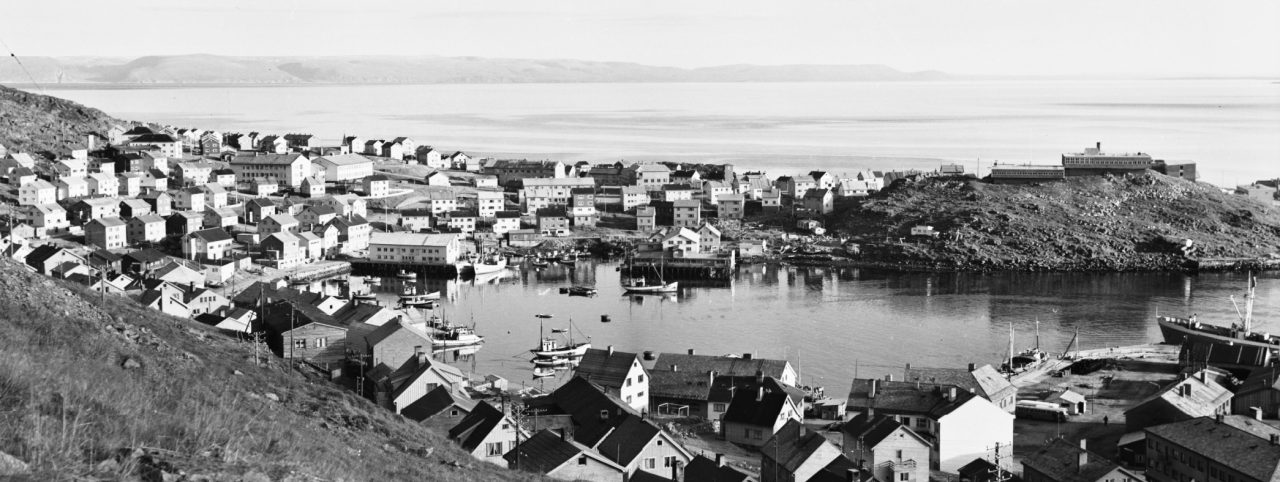
We are in the time after the islet has been made landlocked, and after the Honningsvåg pier has been built. This is the picture that was probably taken during the spring cod fishing, just after there had been a couple of days of good snowy weather. There are probably several Pomor ships here too, and some acquisition vessels further south.
The The story has been published in English Wednesday, September 3, 2026 and continues..