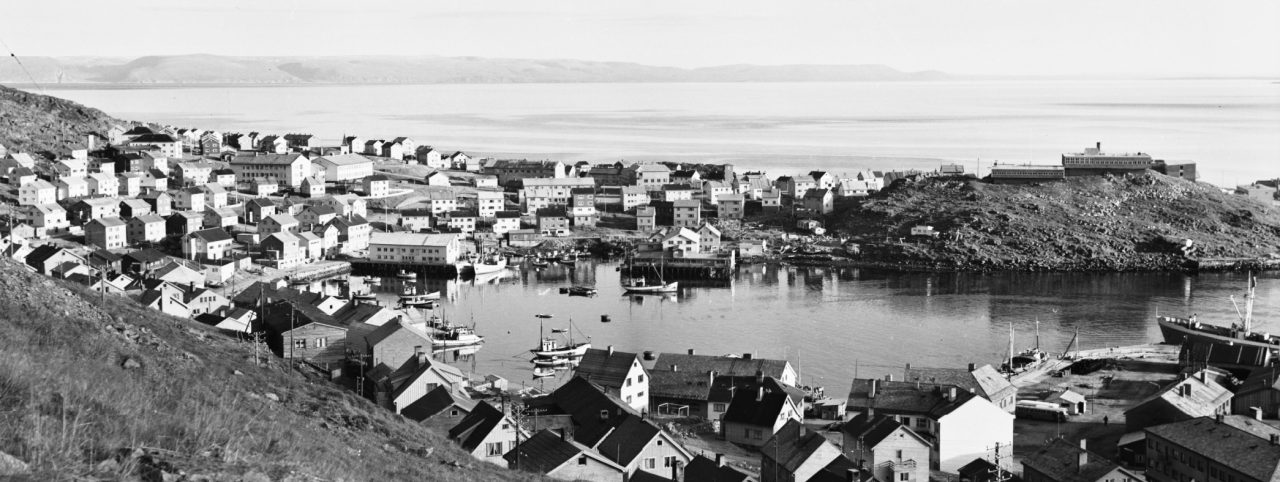
We can see one of the Hurtigruten coastal express ships that had returned to regular service after the war. It is in the process of docking at what, during the reconstruction period, was referred to as “Kollagerkaia.”
The quay was probably already old when the war came, and fairly fragile. But it survived after everything that had been made of coal in the area behind it had burned down in December 1944, a fire that may have continued for several days into January 1945.
 We are now in the area that, in earlier times, and perhaps for some time after Finnmark Bunkerdepot had established its coal depot there, was known as Langstrand.
More than four thousand people in the municipality of which Honningsvåg is the administrative centre had been forced to leave everything they owned when the evacuation was launched (Grepstad 690). Everything that had painstakingly been built up in less than a century had been destroyed. We know that there were only a few permanent residents in Honningsvåg, perhaps nine people, in 1856, when Karelius Løkke arrived and decided to settle in Honningsvåg.
In the municipality, not only houses, shops, fishing stations and barns had been burned down. Of the fishing stations, only the piles supporting the quays remained, sticking up from the sea, with the exception of “Kollagerkaia,” which we can see in the photograph. The oil tanks had been set on fire, and the lighthouse at Helnes had been destroyed.
Those who returned home—the first arriving around 10 June 1945—were confronted with the results.
One of those who had grown up in Honningsvåg, Hjørdis Lia, describes how she experienced being forced to leave her home and board a fishing boat with 24 other people, only to be sent away. She writes that she found it terrible to have to leave everything she owned.
Fortunately, almost every small fishing boat, and every somewhat larger fishing vessel, that people had managed to escape with when the evacuation began was still intact. Now it was time to start again.
Hjørdis Lia, like many others, would never return to settle here. Many others did, certainly most of them. The war was now over, and the barracks era had begun. Eventually they would take part in what has become known as the reconstruction period, while at the same time experiencing a period of modernization.
The authorities put all their efforts into rebuilding what the war had destroyed. It was not to be the responsibility of the people of Finnmark alone; it was the responsibility of the entire country. There was no doubt about that.
The so-called hard 1930s, with unemployment and difficult economic conditions, had left their mark on society before the war, both in the municipality, in Finnmark and throughout the country. Then came the war, bringing rationing and new problems.
The county administration in Finnmark resumed its work as soon as the Germans had withdrawn from eastern Finnmark, and this happened well before the Russians, after almost a year in the area, also withdrew from the country.
After Erling Andreassen had returned, the county governor appointed him temporary mayor until elections could be held.
 Only the church and the cemetery chapel were still standing when the first people arrived from the south around 10 June 1945.
This is what the area around the church looked like after the barracks materials sent north by Einar Gerhardsen’s government had arrived.
Hilmar Hansen described what he experienced when he came home in a letter dated 14 July 1945 in Honningsvåg. He wrote that there were 50 men and one woman in the burned-out fishing village. He then told the people with whom he had lived as a refugee what he had experienced when he returned home, writing:
«I had prepared myself for what things would look like here at home, but unfortunately I must admit that when I arrived here I was met by a sight that far surpassed my expectations. It cannot be fully described. It must be seen, and when I walked over my own and other people’s burned-out plots, I felt almost sick at seeing so much devilish destruction that had been carried out here.»
Hilmar Hansen went on to write that the Germans had not only blown up the water reservoir, but also all the masonry in the town. In order to get through the streets, people had to clear away all the blocks of masonry scattered around. They had smashed all the stoves. Seventeen safes from various buildings had been found, and all of them had been blown open.
Hilmar Hansen had lived in Honningsvåg for 35 years, but even he had difficulty determining which property he was standing beside as he walked around among the shattered cellar walls.
 Prime Minister Einar Gerhardsen and his successor as prime minister, Oscar Torp, came here. In this photograph they have travelled to Kamøyvær to see more of the municipality, not just the town centre.
We can see here how things developed afterwards.
As soon as the government in London had heard about the tragedy, it had begun planning the reconstruction. The plans for how this was to be carried out were ready when Prime Minister Nygaardsvold and his government returned. It had been decided that nobody would be allowed to move back until the burned areas had been rebuilt. Those who were to be allowed to return first were essential construction workers; the rest of the population would come later.
As early as 14 November 1944, while the large Soviet forces were still in eastern Finnmark, the former mayor of Vardø, Peder Holt, was appointed by the government as county governor, with his administration based here. The county administration was thereby restored (Bottolfsen 360).
Peder Holt, the former mayor of Vardø, helped establish a temporary county executive committee. It appointed temporary mayors in the areas the Germans had abandoned, where the Russians remained on friendly terms until 11 September 1945, while waiting for new orders from Moscow, cf. iFOKUS.
As the evacuees began returning during the summer of 1945, municipal administration was also restored farther west in Finnmark. Honningsvåg resident Erling Andreassen had returned and was appointed mayor in November of Nordkapp, the municipality that at the time was still called Kjelvik municipality (Bottolfsen 361).
Einar Gerhardsen’s government had taken office in June 1945, before the new parliamentary election was held on 8 October. The new government, again with Gerhardsen as prime minister, took office on 5 November. Peder Holt then became a minister without portfolio responsible for reconstruction (Bottolfsen 356).
The new government also prohibited people from travelling north, but many defied the ban and travelled north as soon as they could. People streamed northwards. It was impossible to keep them away. The authorities realized that it was not possible to initiate another forced evacuation. Thus, it was the Finnmark residents who returned home without permission who ultimately determined what the authorities had to do.
It became clear that the most essential necessities had to be transported north, along with materials for building temporary accommodation in the form of barracks. This had to begin as quickly as possible. Large numbers of freighters were hired to transport the most essential supplies needed by the population. Then the work began, and it proceeded rapidly.
Harald Hofseth had been employed as chief engineer with the Public Roads Administration in Finnmark until the evacuation. He learned that the government in London had made no plans for organizing the return of the population to Finnmark. What he saw, and realized he had to point out, was that if anything effective was to be accomplished, the people of Finnmark themselves had to take responsibility for raising their communities from the ruins. He made this clear in a letter dated 9 May 1945 to the Norwegian legation in Stockholm, where he was working (Bottolfsen 349).
Honningsvåg was one of the 40 fishing villages that the authorities had decided should be rebuilt. The settlement that had existed before the war had developed rather haphazardly, as we can see in the photographs from the pre-war period.
The settlement that was now to be built was planned centrally. It was to be simple; resources were limited, and there was a great deal of urgency.
Then the work began, and it progressed quickly. The first shipments of building materials arrived as early as August 1945. And, as we could see in the photograph above, large quantities of coal had already arrived.
In 1946, Brødrene Isaksen’s slipway in Storbukt was completed, and the fishing industry had to get underway again. It was a long time before the Hurtigruten ships could resume their service, but fish still had to be transported south. Finotro, A/S Finnmark- og Nord-Troms Fiskeindustri’s large processing plant, was begun in 1951.
Gerhardt Voldnes had already started operations with Sifi, Sild og Fiskeindustri A/S, in 1947. By 1950, more than four hundred permanent homes had been built in the municipality.
Livestock was also needed, and the children needed milk. The authorities acquired sheep and cattle from southern Norway and from Sweden. In the beginning, many people were given the animals free of charge, allowing the agricultural activity that had existed in the municipality to get underway again.
 King Haakon visiting Honningsvåg during the barracks era. To his left is Mayor Erling Andreassen, temporarily appointed by the county governor to help get the municipality functioning again. To his right we see parish priest Odd Lothe.
Odd Lothe had arrived here as parish priest in 1936 and had been dismissed and expelled by the Nazi leadership in the municipality in 1942. In the photograph we can see that he has returned and is walking together with the king and the mayor.
Getting education underway for schoolchildren after people had begun returning was one of the municipality’s most important tasks. Teaching was started at an early stage in temporary barracks at various locations throughout the municipality.
Nine years after the first people returned, the first two permanent school buildings in Honningsvåg had been completed. This happened in 1954, with the schools in Storbukt and Honningsvåg. Mayor Erling Andreassen spoke about this when the newspaper Vestfinmarken interviewed him on 12 November 1954.
Transelated with ChatGPT, but last updated March 1, 2026, with the sources
- Bottolfsen, Øystein (1990), Finnmark Fylkeskommunes historie 1840–1990, Finnmark Fylkeskommune, Vadsø.
- Grepstad, Ottar (2003), Fotefar mot nord, Forlaget Press, Oslo.
Gyllenhaal, Lars (2001), Slaget om Nordkalotten, Historiska Media, 221 05 Lund. - Gorter, Anastasia A. (2015), Frigjøringen i Nord-Norge 1944–1945, Vardø–Arkhangelsk.
- Thomassen, Ottar (1983), “Da vi rømte fra tyskerne”, Årbok for Nordkapp 1983.
Du må være logget inn for å legge inn en kommentar.